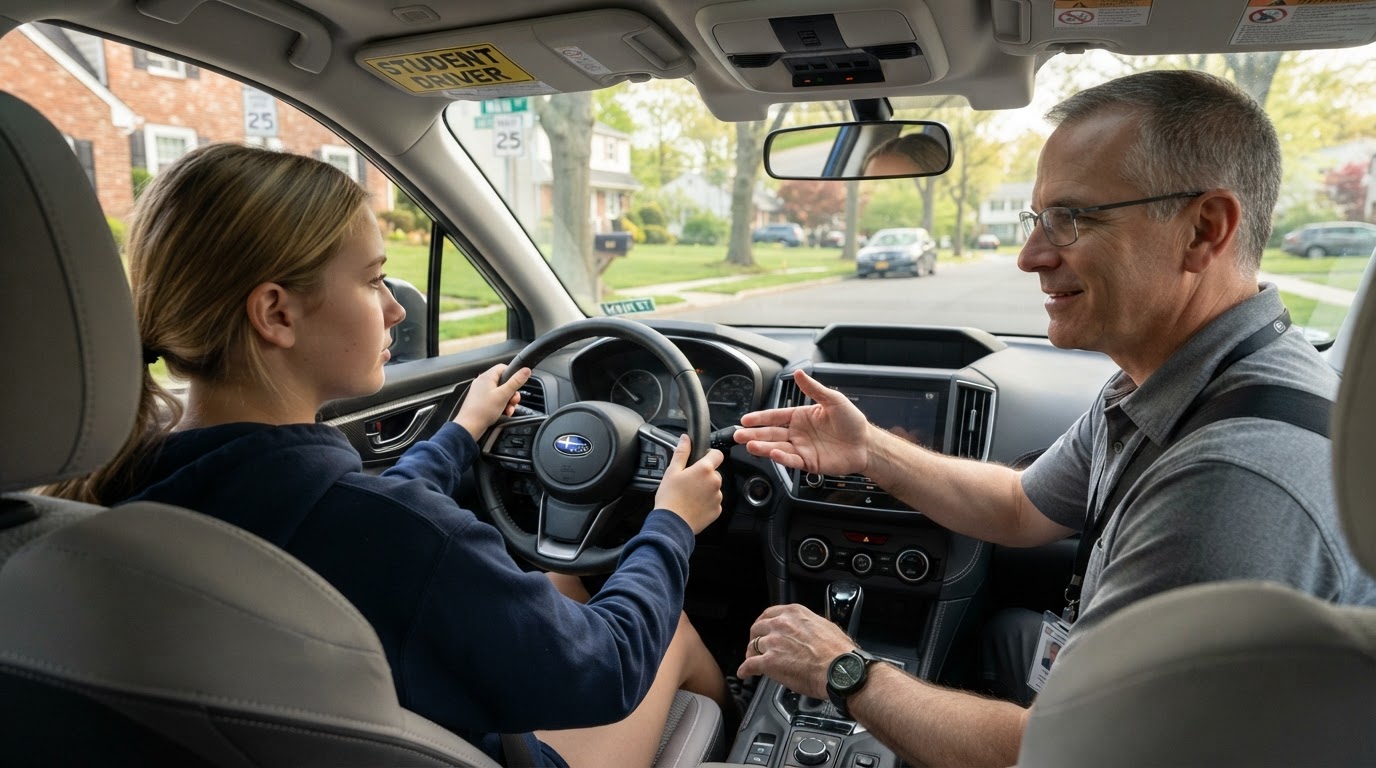
Walking into your New Jersey road test only to be turned away before you ever turn the key is one of the most frustrating things that can happen to a new driver. Every week at testing centers across North Jersey — including the Wayne and Lodi MVC locations — students are turned away not because they couldn't drive, but because of a missing document, an expired inspection sticker, or an emergency brake the examiner couldn't reach.
This comprehensive checklist pulls together every official requirement from the New Jersey Motor Vehicle Commission (NJ MVC), verified directly against current state regulations, so you and your family can arrive on test day completely prepared.
1. Required documents: what to bring in your folder
Before the examiner (officially called a Safety Specialist) inspects your vehicle, they will review your paperwork. Place all of these items in a single folder so nothing gets misplaced in the car:
- Valid NJ examination or learner's permit: Must be signed by the applicant and (for drivers under 18) a parent or legal guardian. The permit must show that the required supervised practice period has been completed.
- 6 Points of ID: You must present the exact same 6 Points of ID you used to obtain your permit. Do not bring photocopies — the MVC requires original or certified copies with raised seals where applicable (such as civil birth certificates or US passports).
- Accompanying NJ licensed driver: You must be accompanied by a driver who is at least 21 years old and has held a valid New Jersey driver's license for at least three full years. That person must drive you to the testing center and remain with you until the test is completed.
- Proof of minimum supervised practice (waiting periods):
- Drivers under 21 (GDL): Must practice supervised driving for at least 6 full months following permit issuance before scheduling or taking the road test. (For 16-year-old Special Learner Permit holders, this 6-month period begins only after completing the mandatory 6-hour behind-the-wheel driving course with a licensed driving school and having the permit officially validated by the MVC.)
- Drivers 21 and older (GDL): Must practice supervised driving for at least 3 full months following permit issuance.
- Non-GDL applicants: Must practice supervised driving for at least 20 days.
- 50-Hour Practice Requirement & Form BA-CSD (Permit Holders Under 21 Only): Under New Jersey law, all permit holders under age 21 must log a minimum of 50 hours of supervised driving practice, including at least 10 hours completed during darkness (night driving).
- Certification Form BA-CSD: The applicant must present the completed NJ MVC Certification of Supervised Driving (Form BA-CSD) signed by a parent, legal guardian, or supervising driver at the time of road testing / probationary license issuance certifying that the 50 practice hours (including the 10 nighttime hours) were completed.
- Drivers age 21 and older are EXEMPT: If you are 21 years of age or older when holding your examination permit, the 50-hour practice log and Form BA-CSD do not apply to you. You are only required to complete the 3 months of supervised driving practice.
- 6-hour driving school course vs. 50-hour practice: These are two separate requirements. The mandatory 6-hour behind-the-wheel course for 16-year-olds is completed with a licensed driving school (such as Adventure Driving School) to get the permit validated. The 50 hours of supervised practice is the ongoing real-world driving practice completed afterward with a licensed parent or supervising adult during the 6-month practice period.
- Road test appointment confirmation: While examiners can look up your scheduled time in their system, having a printed or digital copy of your appointment confirmation prevents confusion at check-in.
2. Vehicle paperwork requirements
The car you use for your road test must have completely current paperwork. The examiner will inspect each document before beginning:
- Valid, unexpired vehicle registration: The original paper registration card must match the vehicle's license plates and VIN.
- Valid NJ insurance card: Must be current and unexpired. Digital insurance cards on a smartphone are accepted by New Jersey law, but having a physical paper card in the glove compartment is strongly recommended in case of device issues.
- Current inspection sticker: The windshield inspection sticker must be valid and unexpired. A vehicle with an expired or missing sticker is automatically denied.
3. Vehicle mechanical and safety requirements
The MVC Safety Specialist will conduct a walk-around inspection before getting inside. Your vehicle will be disqualified if it does not meet every one of these standards:
- Emergency brake access (CRITICAL): The examiner must have unobstructed access to an emergency brake from the passenger seat. This means either a center console handbrake or a foot brake that the examiner can reach. If your center console completely blocks access, or if the vehicle uses an electronic parking-brake switch located solely on the driver's left side, the vehicle cannot be used. This is one of the most common reasons students are turned away.
- Red GDL license plate decals (under 21): Drivers under age 21 taking the test must have red, reflective GDL decals affixed to the top-left corner of both the front and rear license plates. If you lost yours, you must purchase a replacement set ($4.00) at an MVC agency before your test appointment.
- All lights in working order: Headlights (low and high beams), taillights, brake lights, turn signals (front and rear), and hazard flashers must all function properly. A single burned-out bulb will disqualify the vehicle.
- Working horn and windshield wipers: The horn must sound clearly, and wipers must operate smoothly with functional washer fluid.
- Tires in safe condition: No bald spots, visible cords, bulges, or severely low tread.
- Clean and odor-free interior: The vehicle must be reasonably clean with no loose trash, strong odors, or debris on the passenger seat or floorboards.
- Working seatbelts: Both driver and front-passenger seatbelts must latch and retract properly.
- No warning lights: The vehicle must not have active warning indicators such as a Check Engine, ABS, or Airbag light that indicate an unsafe operating condition.
- Window tint restrictions: Tinted front side windows or a tinted windshield are prohibited on test vehicles unless accompanied by an official NJ MVC medical sun-screening exemption certificate.
- No self-parking features: Vehicles equipped with automated self-parking systems cannot use those features during the test (the system must be turned off).
Backup cameras & parking sensors
Official NJ MVC policy explicitly allows backup cameras and factory parking sensors during the road test. However, examiners still require you to physically turn around and look over your right shoulder while backing — relying solely on the screen is scored as improper observation.
4. Using a rental car vs. a driving school vehicle
Many families do not have a personal vehicle that meets all MVC requirements — especially the center-brake rule. New Jersey law allows two alternatives:
- Rental car: Permitted only if the applicant taking the test is explicitly named as an authorized driver on the rental contract and meets the rental company's minimum contract age. Most rental companies do not allow 16- or 17-year-olds on contracts, making this option difficult for teen drivers.
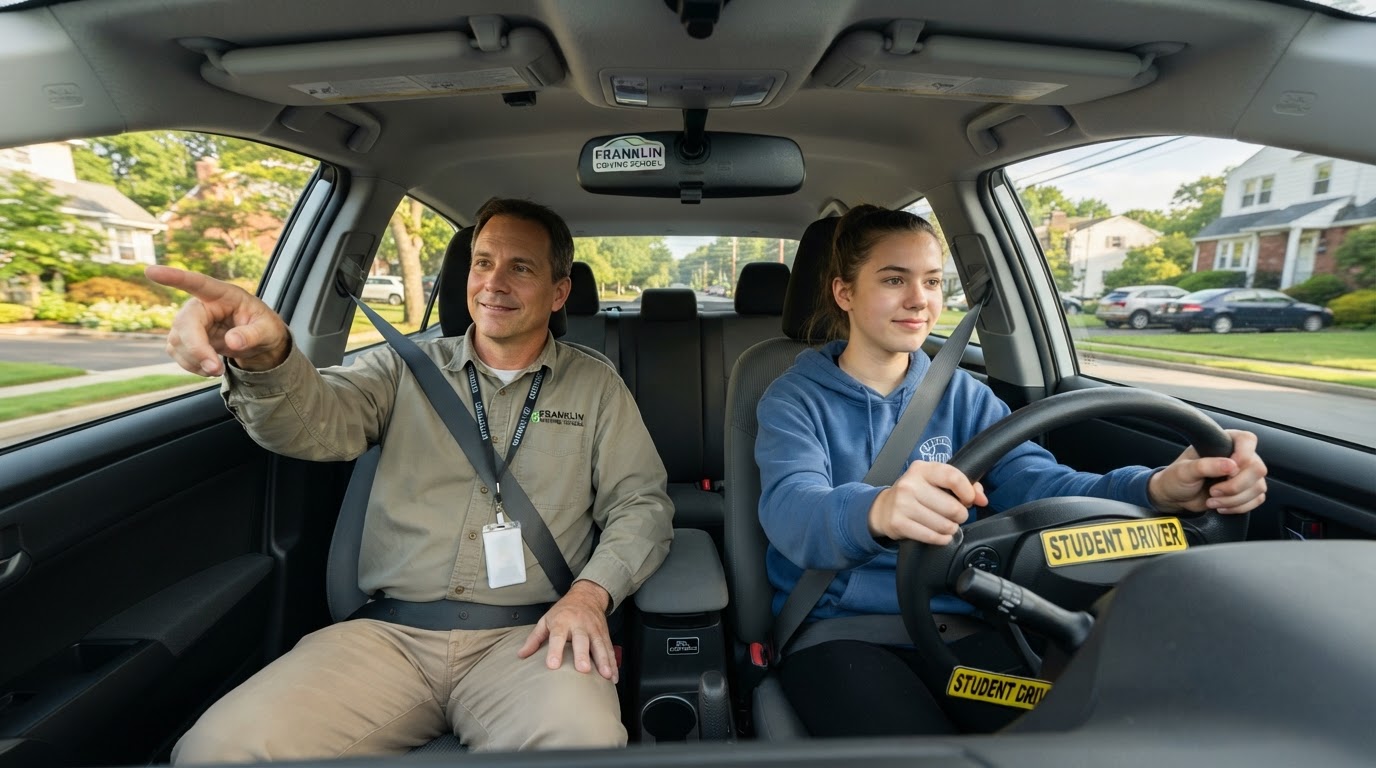
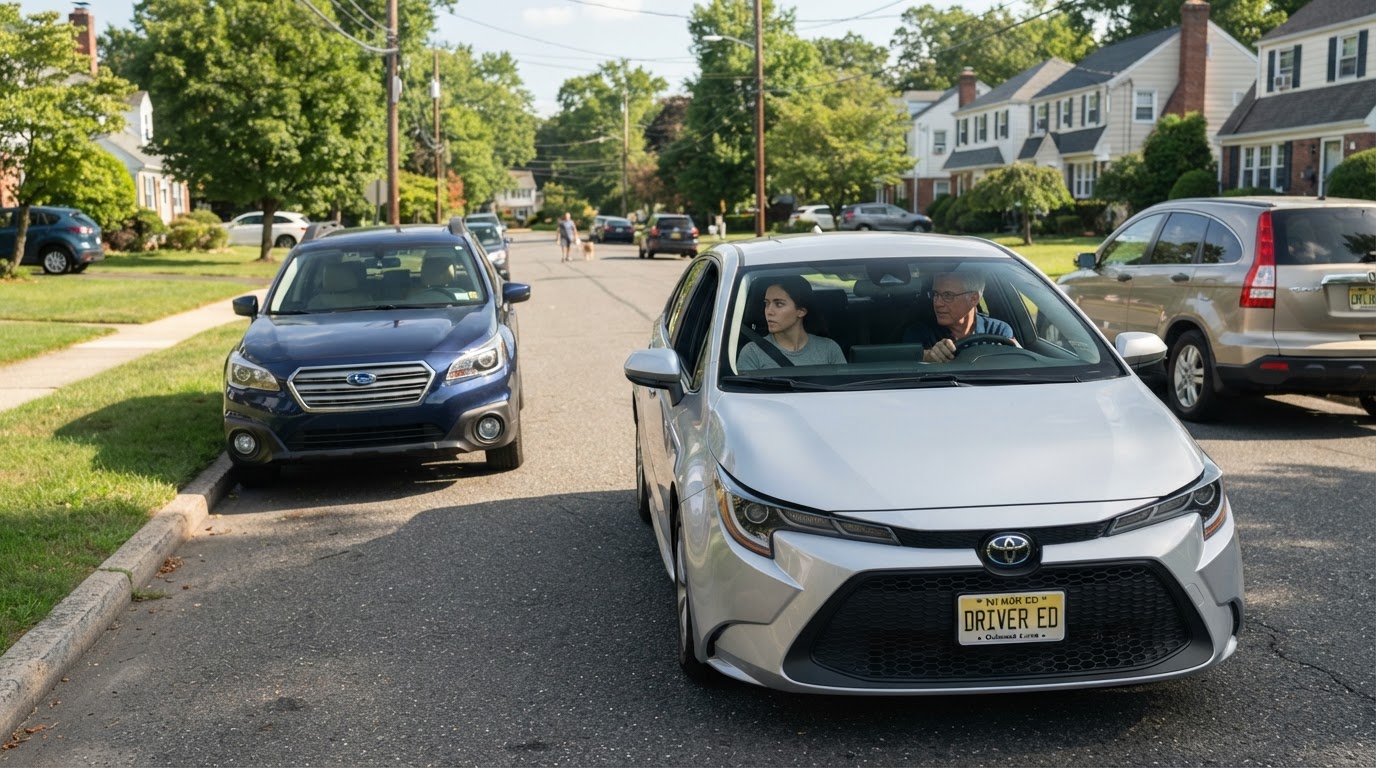
- Driving school vehicle: State-licensed driving school vehicles are explicitly permitted by the NJ MVC. Through our road test service, Adventure Driving School provides a fully compliant, insured, dual-brake training vehicle, accompanies you to the testing center, and ensures all vehicle paperwork is in order.
5. What skills are tested during the NJ road test?
The actual basic road test takes approximately 10 to 15 minutes. The Safety Specialist will evaluate you on specific driving fundamentals:
Driving in reverse
Backing in a straight line for ~100 feet while looking over your right shoulder.
Stopping smoothly
Gentle, controlled deceleration without jerking to a halt.
Stopping at signs
Full, complete stops behind stop lines or crosswalks — no rolling.
Nearing intersections
Scanning left, right, and left again; yielding proper right-of-way.
Turning around (K-turn)
A safe, smooth three-point turn on a narrow street without touching curbs.
Parallel parking
Entering a standard parking space within 6 inches of the curb without hitting cones.
Steering properly
Two hands on the wheel (hand-over-hand or push-pull) with smooth recovery.
Sitting properly
Proper posture, mirror adjustments, and seatbelt fastened before shifting.
6. Notes for Lodi and Wayne MVC road test centers
Most students in Bergen and Passaic County test at either the Lodi MVC or Wayne MVC testing center. While both follow the exact same state scoring rubric, here are a few practical considerations:
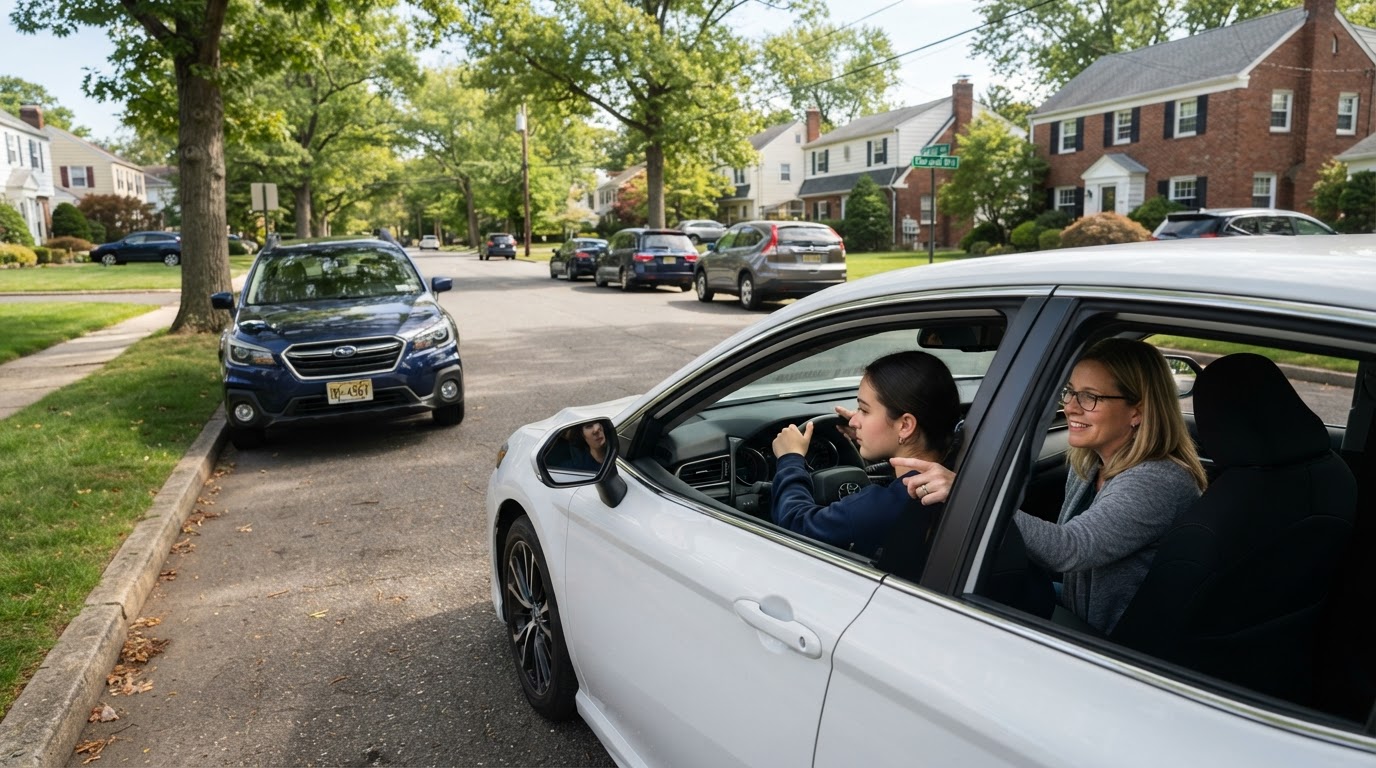
- Both use closed off-road courses: Unlike some states where road tests happen entirely on live public streets, both Wayne and Lodi conduct the basic maneuvers (parallel parking, K-turn, stop signs, straight-line backing) on a dedicated, off-road testing course at the agency.
- You cannot practice on the official course: The MVC strictly forbids unauthorized vehicles from driving on the testing course outside of an active exam. Do not attempt to practice on the course after hours.
- Arrive 15–20 minutes early: Check-in lines can form quickly, particularly during morning and mid-afternoon slots. Arriving early gives you time to organize paperwork and take a breath before the examiner approaches your car.
- Local lesson practice helps: Practicing the maneuvers on real streets in neighboring communities — such as our Paterson driving lessons or lessons in Totowa and Clifton — ensures the skills feel natural rather than memorized.
7. What happens if you pass? (And what if you fail?)
If you pass: The Safety Specialist will endorse your examination permit. You will then take the endorsed permit inside the MVC agency (or schedule an appointment, depending on current agency walk-in policy) to receive your official Probationary Driver's License. Remember that GDL restrictions (passenger limits, curfew hours, and decals) remain in effect for one full year.
If you fail: Do not get discouraged — many safe drivers fail on their first attempt due to nerves or a single missed blind-spot check. Under NJ MVC rules, you must wait at least fourteen (14) days before taking the road test again. Use that two-week window to practice the specific maneuver that cost you points.
8. Quick day-of-test checklist
Before you leave your driveway on the morning of your test, run down this final list:
- Signed permit in hand
- 6 Points of original identification
- Completed and signed Certification of Supervised Driving (Form BA-CSD) certifying 50 practice hours, including 10 hours at night (if applicant is under 21)
- Accompanying NJ licensed driver (age 21+, 3+ years licensed)
- Current, matching vehicle registration card
- Current, valid vehicle insurance card
- Windshield inspection sticker valid and unexpired
- Red GDL decals on front AND rear plates (if applicant is under 21)
- Center emergency brake reachable by the examiner
- All headlights, brake lights, and turn signals checked and working
- Windshield wipers, washer fluid, and horn functional
- Vehicle interior clean and front passenger seat cleared
- Glasses or contacts worn if your permit has a corrective lens restriction
Need help preparing or renting an MVC-ready car?
If your family vehicle doesn't meet the emergency-brake rule, or if you want focused, one-on-one practice on the exact maneuvers the examiner will score, Adventure Driving School is here to help. We have served Bergen and Passaic County families since 1980 with patient, professional instruction (instructor certification DRS-000009).
Learn more about our NJ road test preparation & car service, our teen 6-hour permit program, or our adult driving lessons, or call us directly to schedule your test preparation.